
Business operations are the day-to-day systems, workflows and processes a company relies on to deliver its product or service. A business can run its operations at full speed — phones ringing, calendars full, staff constantly moving — without that activity translating into growth. Speed and motion are not the same as progress. If revenue, customer retention or margin aren’t improving alongside the workload, the business isn’t growing. It’s just busier.
This is one of the easiest traps for a growing business to fall into, because busyness feels like proof of effort. Full inboxes, back-to-back meetings and constant firefighting create the sensation of a business working hard. But activity without alignment to a business goal is just motion — and motion, on its own, doesn’t move a business forward.
The Difference Between Activity and Progress
Activity is anything that keeps people occupied. Progress is activity that measurably moves the business toward a specific goal — more revenue, better margins, faster delivery, stronger retention. The two overlap far less often than most operators assume.
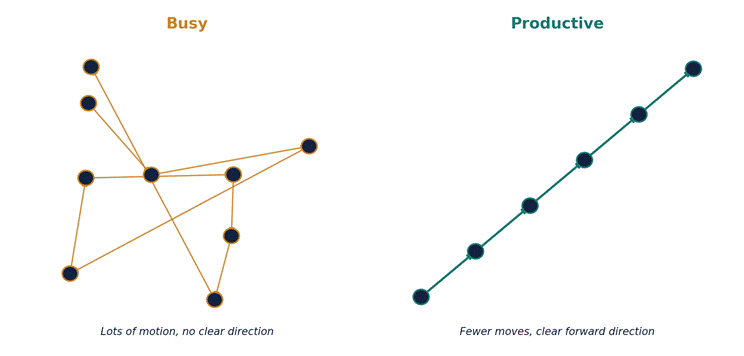
A team can spend an entire week responding to the same category of customer complaint, updating the same spreadsheet by hand, or re-explaining the same process to a new hire — and every one of those hours will feel productive in the moment. None of it addresses why the complaint keeps recurring, why the spreadsheet is still manual, or why onboarding still isn’t documented. That’s activity solving symptoms while the underlying operational gap stays exactly where it was.
Busy is what a business looks like from the inside. Growing is what it looks like from the outside — in the numbers.
Where Operational Inefficiency Hides
Operational inefficiency rarely looks dramatic. It shows up as small, repeated friction that everyone has learned to work around instead of fix:
- Staff manually re-entering the same data across multiple systems
- Customers waiting longer than necessary for responses that could be automated
- Decisions delayed because the right information isn’t accessible when it’s needed
- New team members taking months to reach full productivity due to undocumented processes
- Reports assembled by hand each week instead of generated automatically
Individually, each of these feels minor. Together, they quietly cap how fast a business can grow — because every hour spent working around a broken process is an hour not spent growing the business.
How This Shows Up in Customer Experience
Customers don’t experience a business’s internal busyness directly — they experience its output. A support team that’s constantly overwhelmed still produces slow response times, no matter how hard everyone is working. A booking process that requires three manual confirmations still frustrates the customer, regardless of staff effort behind the scenes.
This is often where operational inefficiency becomes visible from the outside first: churn rises, reviews mention slow service, referrals slow down — all while internal teams feel busier than ever. The disconnect between internal effort and external experience is one of the clearest signs that activity isn’t converting into progress.
Team Productivity vs Team Activity
A team that looks productive — always in meetings, always responding to something — isn’t necessarily the team producing the most value. Genuine productivity is measured by output against goals, not hours filled. Teams operating in a reactive, constantly-busy mode are frequently the ones with the least structure: no clear process for recurring work, no defined ownership, and no room to focus because everything feels urgent.
Often this traces back to a single bottleneck — see “The Founder Shouldn’t Be the Operating System.” for how founder dependency specifically creates this pattern.
Ironically, businesses that build in structure — clear processes, defined ownership, less reactive firefighting — often look less busy on the surface while producing measurably more.
Data and Decision-Making
Busy businesses often make decisions on instinct because there’s no time to look at data properly — which, in a loop, creates more busyness, because instinct-based decisions have a higher error rate than data-informed ones. A business with accessible, centralised data can spot a slowing sales channel, a rising cost centre, or a bottleneck in fulfilment before it becomes a crisis. A business without it finds out only after the damage is visible in quarterly numbers.
Where Technology Adoption Actually Helps
Technology doesn’t fix busyness by adding more tools — it fixes it by removing the manual, repetitive work that creates busyness in the first place. This is the same trap covered in “Your Business Doesn’t Need More Software. It Needs a Better Digital Strategy.” — buying tools without a roadmap usually adds to the busyness rather than resolving it. Automating data entry, centralising customer information, or connecting systems that previously required manual updates directly frees capacity that can be redirected toward growth-generating work rather than maintenance work. Not every process is a good automation candidate, though — see “Stop Automating Everything. Automate What Slows Your Business Down.” for how to identify which ones actually move the needle.
Introducing The Snazzy Business Growth System™
To help business leaders see how these threads connect, we built The Snazzy Business Growth System™ — a model showing the five levers that, together, convert operational activity into sustainable business growth.
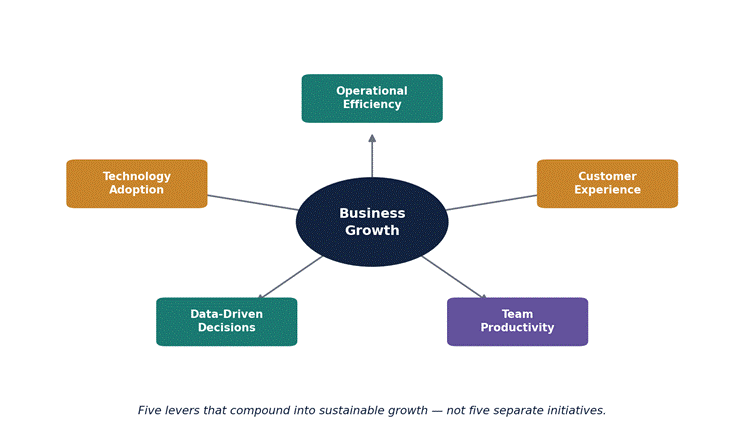
The five levers work as a system, not a checklist: operational efficiency frees up time and resources; that capacity improves customer experience; a less reactive team becomes genuinely more productive; better data enables better decisions; and the right technology adoption is what makes each of the other four levers durable rather than a one-time fix. Strengthening one lever in isolation helps briefly. Strengthening all five together compounds.
The Pattern Across Real Estate, Hospitality, Logistics and Healthcare
This dynamic isn’t sector-specific. The same pattern — activity mistaken for progress — shows up across every industry we work with, just wearing a different disguise.
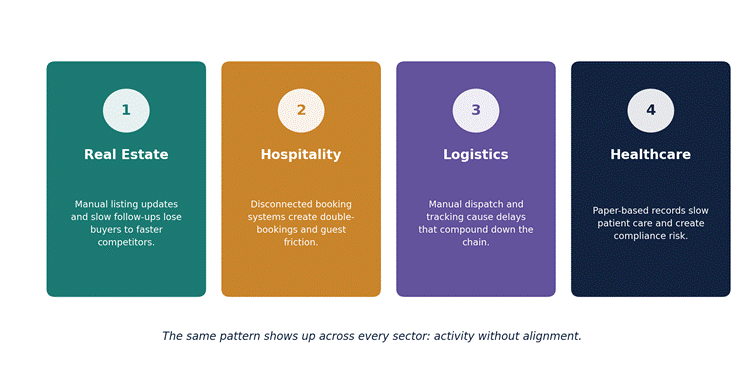
| Industry | Where Activity Hides Progress | What a System-Led Fix Looks Like |
| Real Estate | Agents chase leads manually across spreadsheets and WhatsApp threads | Centralised CRM with automated follow-up sequences |
| Hospitality | Front desk and booking platforms don’t sync, causing double-bookings | Unified booking system with real-time availability sync |
| Logistics | Dispatch relies on phone calls and manual tracking sheets | Automated dispatch and live shipment tracking |
| Healthcare | Patient records are paper-based or siloed across departments | Integrated digital records accessible across care teams |
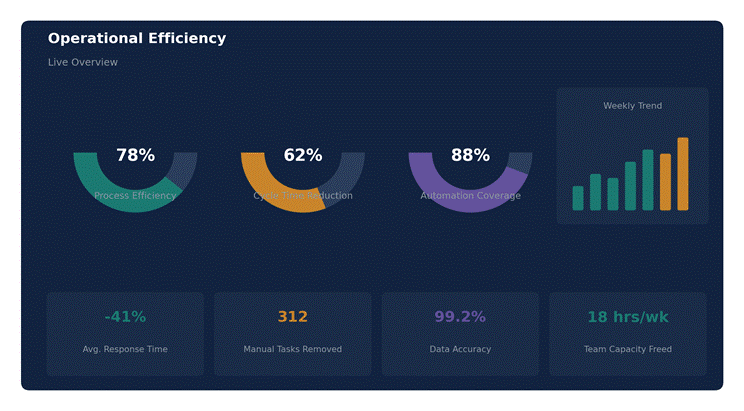
What This Looks Like in Practice: An Operational Efficiency Snapshot
The illustration below is a conceptual example of how operational efficiency gains typically get tracked once a business shifts from manual, reactive workflows toward connected, system-led ones — not a claim about any specific business’s actual results.
Frequently Asked Questions
How can a business tell if it’s busy or actually growing?
Compare internal activity against external, measurable outcomes over the same period — revenue, retention, margin, or delivery speed. If the workload has increased but those numbers haven’t moved, the business is busier, not bigger.
What’s the fastest way to reduce operational inefficiency?
Start with the most frequently repeated manual tasks — data entry, reporting, follow-ups — since these create the most compounding friction and are usually the easiest to fix with existing, connected technology.
Does more technology automatically mean better business operations?
No. Technology only helps when it’s applied to a genuine capability gap and connects to the systems already in use. Adding disconnected tools on top of a busy, reactive operation usually adds complexity rather than removing it.
The Takeaway
A full calendar and a constantly busy team aren’t evidence of a growing business — they’re only evidence of a busy one. Real growth shows up in the numbers that matter: revenue, retention, margin, and the capacity to take on more without everyone working harder to stand still. Closing the gap between activity and progress starts with seeing clearly where operational effort isn’t converting into outcomes — and building the systems that let it finally does.
Talk to Snazzy about Your Business

Joshua Fasinu is a Computer Science student and technology enthusiast passionate about using technology to solve real-world problems. At Snazzy Digital Techspace, he contributes to technology, automation, product development, and digital innovation, while also exploring AI, software development, and business process automation.
He is driven by a desire to learn, build, collaborate, and create digital solutions that make work and everyday life better.