If You Can’t Measure It, You’re Probably Guessing
Data-driven decision making is the practice of basing business choices on measured, verifiable information rather than assumption, habit or instinct. It means every significant decision — pricing, hiring, inventory, marketing spend — is checked against real numbers before it’s made, not justified with numbers after the fact. Most businesses believe they already do this. Most, in practice, are running on a mix of memory, anecdote and whoever spoke most recently in the meeting.
This isn’t a criticism of judgement — experienced leaders develop real intuition over years in an industry. The problem is that intuition without data has no way to check itself. It feels exactly as confident when it’s right as when it’s wrong, and a business only finds out which one it was after the decision has already cost time or money.
Why Businesses Operate on Assumptions
Assumption-based decision-making isn’t usually a choice — it’s what fills the gap when data is missing, scattered, or too slow to be useful. A founder doesn’t decide to guess; they decide based on the clearest information available in the moment, and if that information is “what happened last time” or “what a competitor seems to be doing,” that’s what gets used.
- Data exists but lives in disconnected systems no one has time to combine
- Reports take days to compile, so decisions get made before the numbers are ready
- Nobody has defined which metrics actually matter for a given decision
- Past decisions were never measured, so there’s no track record to learn from
- Instinct has worked often enough in the past to feel reliable, even where it’s actually just luck
Every business already has data. The real question is whether it’s organised enough to be useful before the decision is made — not after.
The Cost of Poor Data
Guessing isn’t free — it just hides its cost until later. Inventory ordered on gut feel becomes stock that doesn’t sell or shelves that run empty at the worst moment. Marketing spend allocated by impression rather than by measured return quietly funds the channel that feels active rather than the one that’s actually converting. Hiring decisions made on interview chemistry rather than defined performance data produce inconsistent teams no one can explain.
None of these costs show up as a single dramatic loss. They accumulate as a business that consistently performs slightly worse than it could — a pattern that’s almost invisible without something to measure it against.
What Business Leaders Should Actually Measure
Measuring everything is as unhelpful as measuring nothing — it produces noise instead of clarity. The right starting point isn’t more data. It’s identifying the handful of numbers that would actually change a decision if they moved.
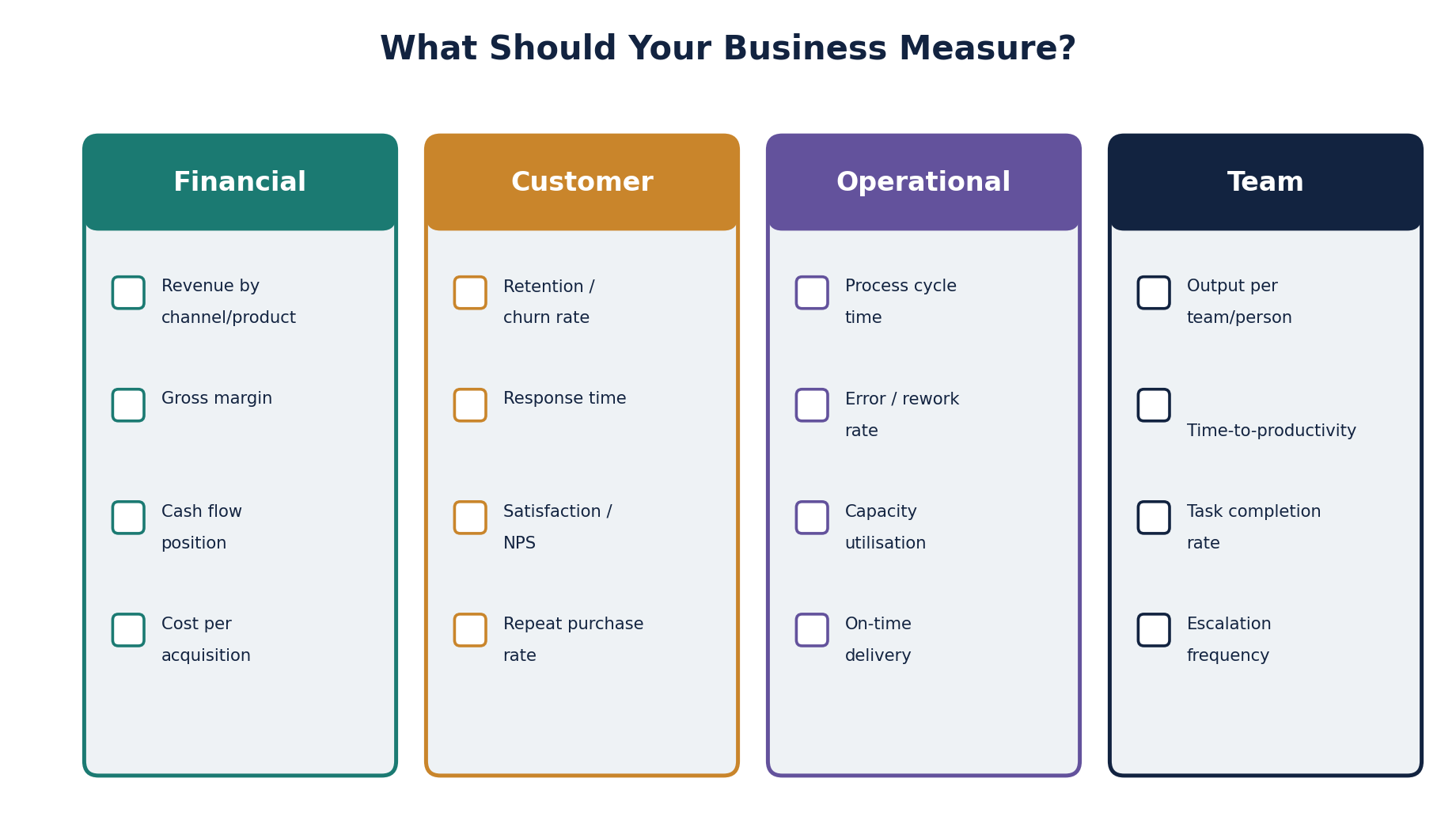
A useful test for any metric under consideration: if this number changed significantly next month, would it change what leadership actually does? If the honest answer is no, it’s a vanity metric — worth glancing at occasionally, but not worth building a report around.
Turning Operational Activity Into Useful Information
Data doesn’t start as a dashboard — it starts as raw operational activity: a sale, a support ticket, a delivery, a shift log. Turning that activity into decision-ready information requires three things happening consistently: the activity has to be captured somewhere structured (not a notebook or someone’s memory), it has to be aggregated regularly rather than assembled by hand when someone finally asks, and it has to be presented in a form a decision-maker can actually interpret at a glance.
Most businesses have the first part — the activity happens and leaves some trace. Where the process usually breaks down is the second and third steps: nobody owns pulling it together, and even when it is pulled together, it’s a spreadsheet dense enough that nobody outside the person who built it can read it quickly.
Dashboards and Reporting: Making Data Usable
A dashboard’s job isn’t to hold every number a business generates — it’s to surface the handful that matter, updated often enough to be trustworthy, in a format a leader can scan without needing an analyst to translate it.
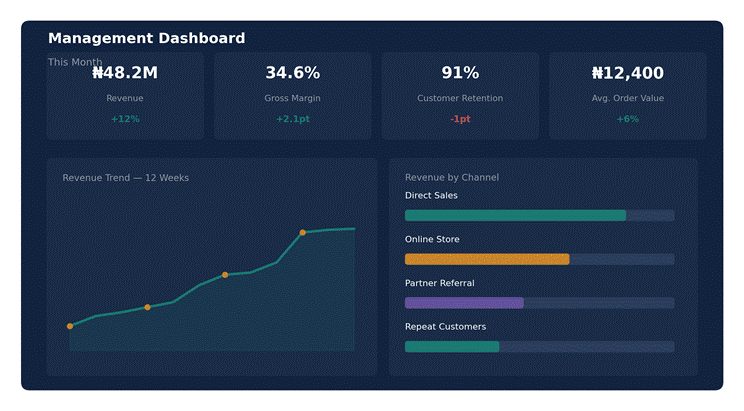
Good reporting answers a specific question at a glance — is revenue trending up or down, which channel is actually driving it, is retention holding — without requiring the reader to dig. If a dashboard needs a fifteen-minute walkthrough before anyone can use it, it’s a reporting tool built for the person who made it, not for the leader who needs to act on it.
Introducing The Snazzy Decision Intelligence Loop™
To make this practical rather than abstract, we built The Snazzy Decision Intelligence Loop™ — a five-stage cycle that shows how data becomes a decision, and how that decision becomes the next round of data.
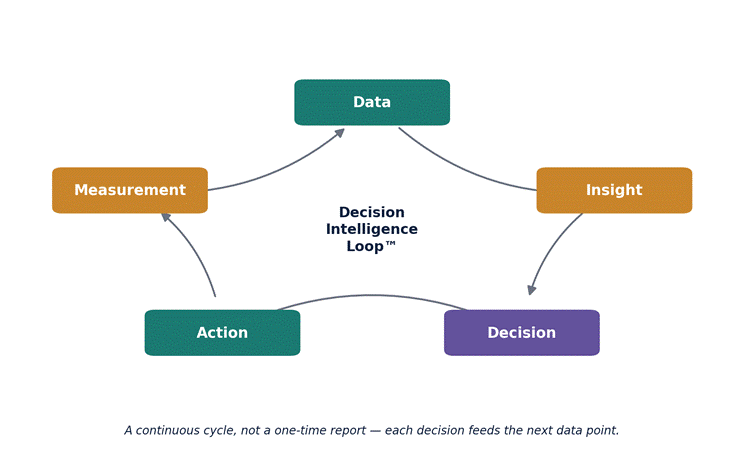
Data is collected from operations. Insight is what that data means once it’s aggregated and compared against a benchmark or trend. Decision is the choice made based on that insight, not despite it. Action is the decision actually being carried out — the step many businesses skip by stopping at the report. Measurement closes the loop by tracking whether the action produced the intended result, which becomes the next round of data.
The loop only creates value if it’s continuous. A business that measures once a quarter and calls it “data-driven” is really just doing slow guessing with extra steps. The businesses that benefit most treat measurement as an ongoing habit built into the operation, not an occasional report.
This is closely tied to a pattern we cover in “A Busy Business Isn’t Always a Growing Business.” — businesses that skip the measurement step often can’t tell the difference between being busy and actually growing.
Using Data to Identify Opportunities and Problems
The most valuable use of business data isn’t confirming what leadership already suspects — it’s surfacing what nobody has noticed yet. A slow decline in repeat purchase rate, a support channel quietly growing more expensive per resolution, a product category outperforming expectations without anyone flagging it — these are the patterns that consistent measurement catches early, while instinct-only management tends to notice only once the trend has become a crisis or a missed opportunity.
Building the systems that generate this kind of reliable data often starts with the same infrastructure gap covered in “Your Business Doesn’t Need More Software. It Needs a Better Digital Strategy.” — disconnected tools rarely produce clean, comparable data on their own.
Frequently Asked Questions
What does data-driven decision making actually mean in practice?
It means a business defines the specific metrics relevant to a decision in advance, tracks them consistently, and checks proposed decisions against that data before committing — rather than justifying a decision with data after it’s already been made.
What’s the minimum data a small business needs to start?
Start with one metric in each core area — revenue by channel, a customer retention or satisfaction figure, one operational efficiency measure, and one team output measure — rather than attempting comprehensive tracking across the whole business at once.
How often should a business review its data?
Frequency should match how often the underlying decision changes: daily or weekly for fast-moving metrics like sales and support volume, monthly for slower-moving ones like retention or margin — reviewed consistently enough that trends are caught while they’re still small.
The Takeaway
A business that makes decisions on assumption isn’t necessarily making bad decisions — but it has no reliable way to know, and no way to improve systematically, because there’s nothing to learn from. Data-driven decision making isn’t about turning a business into a spreadsheet. It’s about giving leadership a way to check its own instincts before they become expensive, and a way to catch what instinct alone would miss.
Start with the Decision Intelligence Loop™: pick the handful of metrics that would actually change what you do, build the habit of reviewing them consistently, and close the loop by measuring whether your decisions actually worked.

Joshua Fasinu is a Computer Science student and technology enthusiast passionate about using technology to solve real-world problems. At Snazzy Digital Techspace, he contributes to technology, automation, product development, and digital innovation, while also exploring AI, software development, and business process automation.
He is driven by a desire to learn, build, collaborate, and create digital solutions that make work and everyday life better.