Productivity problems are usually process problems wearing a people costume.
Business process improvement is the practice of redesigning how work actually flows through a business — who owns each step, how handoffs happen, and where delay gets introduced — so output improves without simply asking people to work harder. When a team seems slow, the instinct is to blame effort, skill or headcount. But in most businesses, the real bottleneck is upstream: unclear ownership, undocumented handoffs and steps that were never designed, only inherited. Fix the process, and the same team — with the same headcount — usually gets faster on its own.
If everyone on your team is working hard and the business is still slow, the problem was never effort. It was design.
Why Businesses Blame People Before They Blame Process
Blaming a person is fast, visible and satisfying. Blaming a process is slower, less visible, and requires admitting that leadership designed — or failed to design — the system everyone is stuck operating inside. So when a deadline slips, the easiest story is “they need to move faster,” even when three other people were quietly waiting on the same handoff for two days.
Research on workplace productivity consistently finds that most delay in knowledge work happens in the white space between tasks — handoffs, approvals, waiting — not inside the tasks themselves. A capable employee inside a badly designed process will always look slow, no matter how skilled they are.
The Hidden Costs of Inefficient Workflows
Inefficient workflows rarely show up as a single dramatic failure. They show up as small, repeated costs that are easy to miss individually and expensive in aggregate: the client update that goes out a day late because no one owned the final review step; the invoice that gets re-keyed because two systems don’t share data; the new hire who takes twice as long to ramp up because the process only exists in someone’s head.
These costs rarely appear on a P&L as “process cost.” They show up as overtime, as headcount requests, as customer churn attributed to “service quality.” By the time leadership notices, the instinct is almost always to add people or add software — both of which make a badly designed process more expensive to run, not less broken.
Creating Accountability Through Process Design
Accountability doesn’t come from telling people to “own it more.” It comes from a process design that makes ownership visible: every step has exactly one owner, every handoff has a defined trigger, and every delay is traceable to a specific point instead of a general vibe that “things are slow.”
This is the uncomfortable part for many leadership teams: designing accountability into a process often reveals that no one owns a step that everyone assumed someone else was handling. Surfacing that gap isn’t a criticism of the team — it’s usually the single highest-leverage fix available, because it costs nothing to assign ownership that should have existed already.
Introducing the Process Performance Loop™
To turn this from a mindset into a repeatable method, Snazzy developed the Process Performance Loop™ — a continuous four-stage cycle for finding and fixing the real source of slowness in a business.
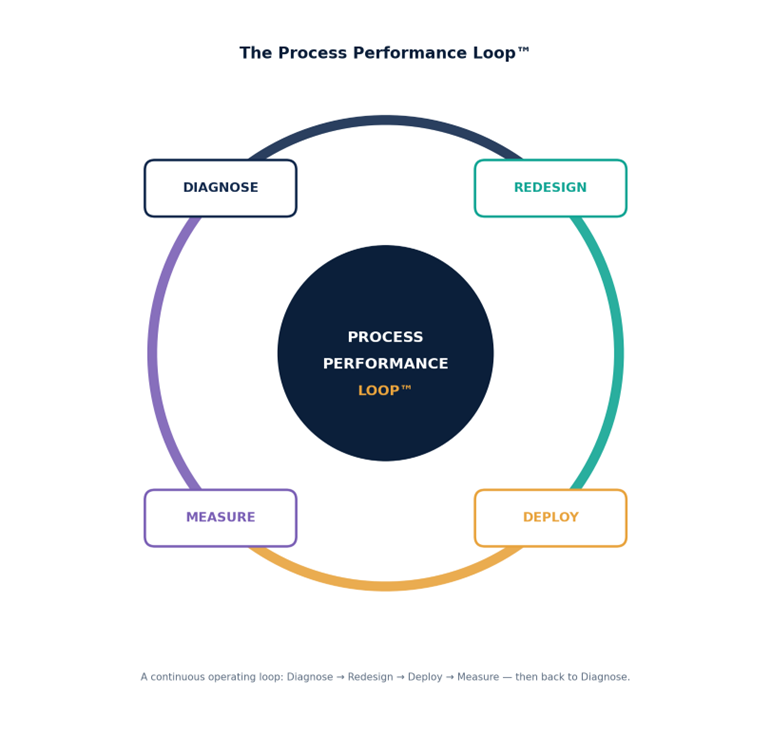
The Process Performance Loop™ — a continuous cycle of Diagnose, Redesign, Deploy and Measure.
- Diagnose — map the process as it actually runs today, including the workarounds nobody admits to using.
- Redesign — assign one owner per step and remove handoffs that don’t add value.
- Deploy — roll out the redesigned process with the people who run it daily, not just leadership sign-off.
- Measure — track cycle time and error rate at each step, then feed findings back into the next Diagnose stage.
Because the loop never technically ends, a process stays healthy as the business grows — it doesn’t quietly decay back into firefighting six months after a single improvement project wraps up.
Before and After: What Process Redesign Actually Looks Like
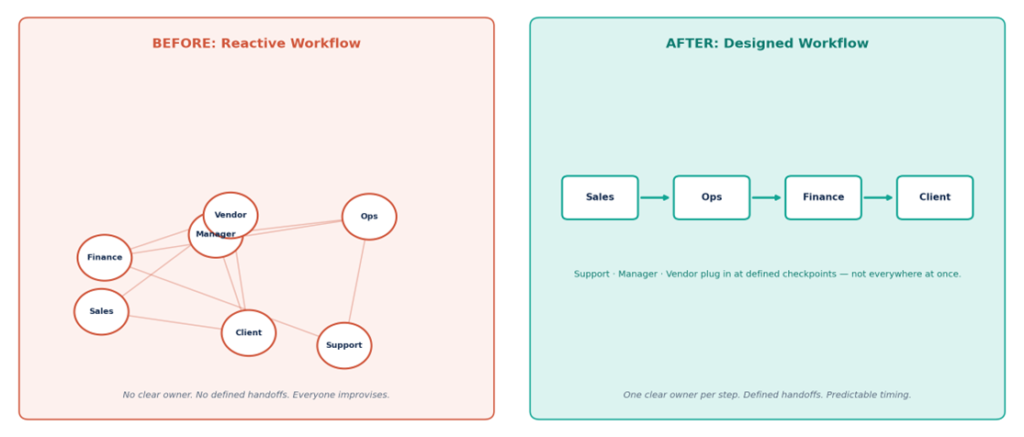
The same work, before and after a defined process: fewer connections, clearer ownership, predictable handoffs.
The difference between a reactive workflow and a designed one is rarely about doing less work — it’s about doing the same work with far fewer unplanned connections. In the “before” state, every department can reach every other department at any time, which feels flexible but produces constant interruption. In the “after” state, information moves through defined checkpoints, and specialist input — support, a manager, a vendor — is pulled in deliberately rather than looping in everyone by default.
Flexibility that lets anyone interrupt anyone at any time isn’t agility — it’s the absence of a process.
Where Automation Actually Adds Value
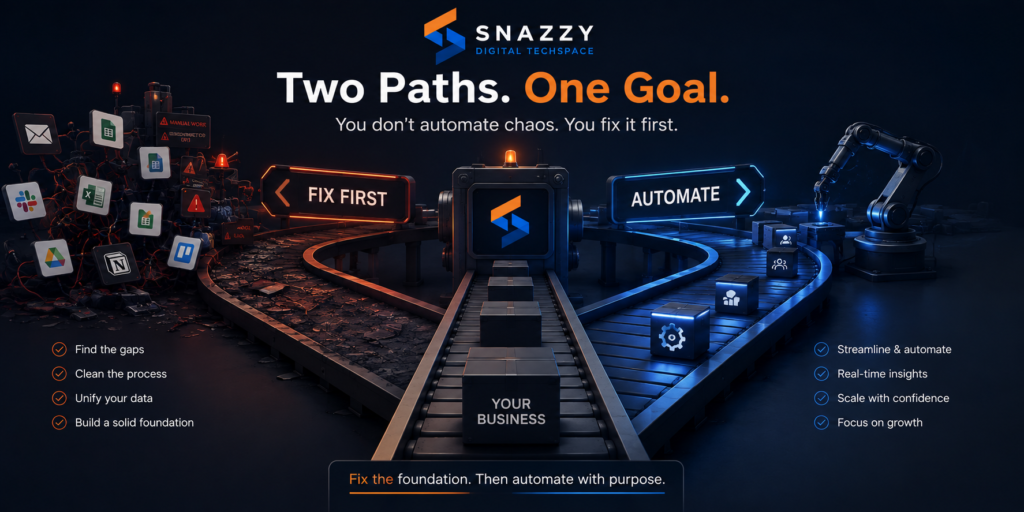
Automation is not where process improvement starts — it’s where it pays off, and only once. Automating a broken process just produces broken output faster and at greater volume. Automation adds real value only after a process has a clear owner, a documented sequence and a stable handoff point, because at that stage automation is removing friction from a process that already works, rather than papering over one that doesn’t.
A useful test: if you can’t currently describe a process in five or six steps without saying “it depends who’s free,” it isn’t ready for automation yet. Fix the design first.
Blame the People vs. Fix the Process
| Signal | Blame the People | Fix the Process |
| A deadline is missed | “They need to move faster.” | “Where did the handoff stall, and why?” |
| Errors keep recurring | “They need more training.” | “Is the same step producing the same error for everyone?” |
| A client complains | “That rep dropped the ball.” | “Who actually owned that step, and was it clear?” |
| Work piles up | “We need to hire.” | “Is work piling up because of volume, or because of rework?” |
Building Operational Excellence for Long-Term Growth
Operational excellence isn’t a state a business arrives at once and keeps forever — it’s a maturity level a business operates at, and that level can rise or fall depending on whether processes are actively managed.
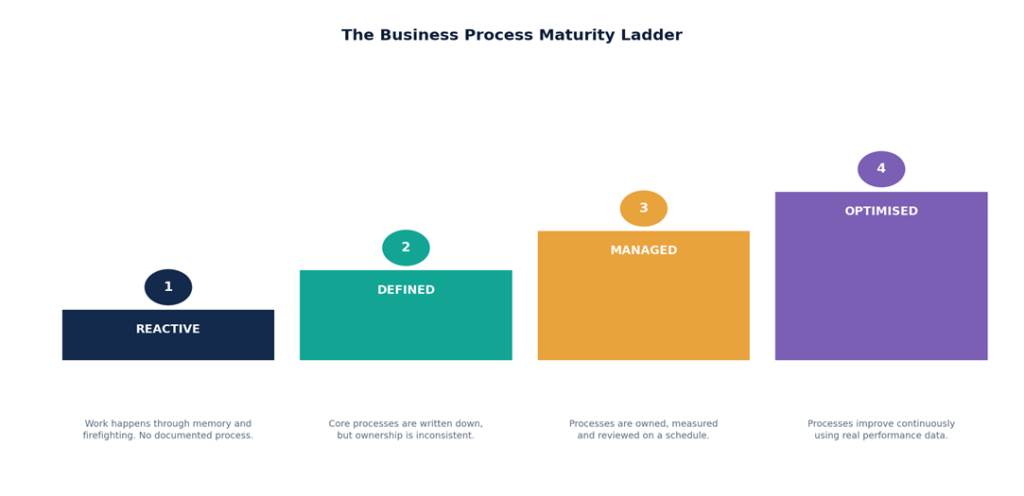
Most growing businesses sit between Reactive and Defined — the biggest productivity gains usually come from reaching Managed.
Most businesses Snazzy assesses sit between Reactive and Defined: some processes are documented, most still depend on institutional memory. The jump from Defined to Managed — where processes are actually measured and reviewed on a schedule — is where the largest, most durable productivity gains tend to show up, because that’s the point at which problems get caught before they become customer-facing.
Frequently Asked Questions
How do I know if my problem is people or process?
Look at whether the same type of delay or error happens regardless of who is doing the work. If it does, it’s a process problem. If performance varies sharply between individuals doing the identical, well-defined process, that’s more likely a people or training issue.
Isn’t hiring faster than redesigning a process?
Hiring adds capacity to a broken process, which usually just produces the same errors at higher volume and higher cost. Redesigning first, then hiring into a working process, is slower to start but cheaper and more durable.
How long does a process redesign take?
A single core process (onboarding, fulfilment, invoicing) typically moves through Diagnose and Redesign in two to three weeks, with Deploy and initial Measure data available within another month.
Do small businesses need this, or only large ones?
Smaller teams often need it more, because there’s no slack to absorb a broken handoff — one unclear step can consume a disproportionate share of a small team’s total capacity.
Your Process Improvement Checklist
☐ Pick one process that regularly causes complaints or delay and map every actual step, including workarounds.
☐ Identify every handoff with no single named owner.
☐ Remove or merge steps that exist only because “that’s how it’s always been done.”
☐ Assign one accountable owner per remaining step.
☐ Set one measurable target (cycle time or error rate) and review it monthly.
☐ Only automate once the process runs the same way twice in a row without intervention.
The Bottom Line on Business Process Improvement
Before asking a team to work harder, it’s worth asking whether the process they’re working inside was ever actually designed — or just inherited. Business process improvement consistently uncovers more available productivity than hiring or automation alone, because it removes friction at its source instead of adding capacity around it. Teams rarely need to move faster. They need a system that stops slowing them down.
Curious where your own workflows are losing time? Schedule a Business Assessment with Snazzy Digitals, or read our related insight on what Business Technology Systems (BTS) really means.

Joshua Fasinu is a Computer Science student and technology enthusiast passionate about using technology to solve real-world problems. At Snazzy Digital Techspace, he contributes to technology, automation, product development, and digital innovation, while also exploring AI, software development, and business process automation.
He is driven by a desire to learn, build, collaborate, and create digital solutions that make work and everyday life better.