Technology ROI is the measurable business value a technology investment returns compared with what it costs in total. It is calculated by subtracting the full cost of ownership from the value gained, then dividing by that cost. The important word is value. A system that was bought, installed and paid for every month but is barely used returns almost nothing, however good the software is. The question that decides ROI is not what the technology costs. It is what the business gained from it.
Most businesses track the first half of that equation carefully and the second half hardly at all. Invoices are easy to count. Value takes deliberate measurement, so it often goes unmeasured, and technology that is not delivering quietly keeps renewing.
Purchase Price vs Total Cost of Ownership
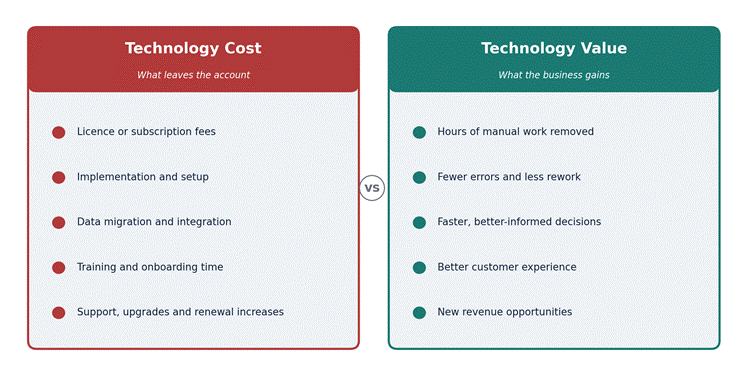
The price on the proposal is rarely the price of the technology. Total cost of ownership includes everything required to make the technology work and keep it working, and most of it arrives after the contract is signed.
- Subscriptions and licences, including renewal price increases
- Implementation, configuration and setup
- Data migration and integration with existing systems
- Training, onboarding and the time staff spend learning
- Ongoing support, maintenance and administration
A business that compares tools on the headline subscription fee is comparing the smallest and most visible part of the cost. A cheaper tool that is hard to adopt can cost far more than a pricier one people actually use.
The Cost of Technology Nobody Uses
Unused technology is the most avoidable cost on the list, because the business pays in full and receives nothing. It happens in familiar ways: licences bought for a whole team when only part of it needed them, tools replaced but never cancelled, features paid for and never switched on, and systems people quietly work around.
The scale is larger than most leaders expect. Zylo’s 2026 SaaS Management Index puts the average organisation’s annual waste on unused software licences at roughly $19.8 million, against average annual SaaS spend of about $55.7 million, which is around a third of what is spent. Separately, Flexera’s State of ITAM research has estimated that enterprises waste up to roughly 30% of their software budgets on underused or redundant licences. Estimates vary by source and company size, but they point the same way: a significant share of software spend delivers no return.
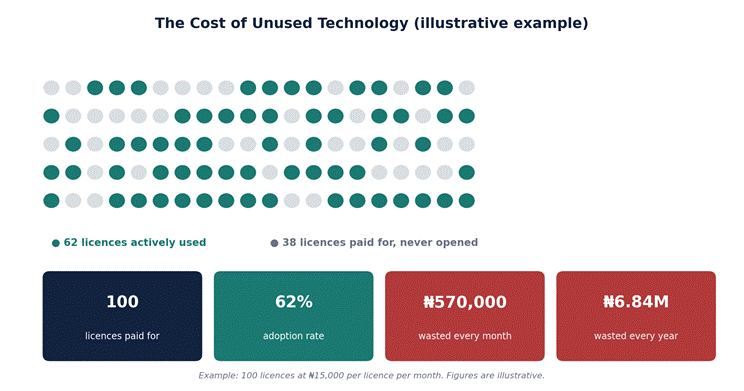
Unused technology is not a saving that failed to arrive. It is a bill that arrives every month.
Why Adoption Is the Hinge of Technology ROI
Every benefit technology can offer, from time saved to better data, depends on people actually using it in their daily work. Adoption is the point where cost can turn into value. Below it, the business is paying for potential. Above it, the business starts collecting returns.
Adoption is also where most ROI problems begin. A system that was configured for how the vendor imagines the business works, introduced with one training session and no follow-up, tends to be used by the enthusiastic minority and avoided by everyone else.
For how to get adoption right from the start, see “Technology Doesn’t Fail. Implementation Does.” and its seven-stage Implementation Cycle™.
Introducing The Snazzy Technology Value Model™
To make technology value measurable, we built The Snazzy Technology Value Model™. It follows an investment from what it costs to what it delivers, in five steps: Cost, Adoption, Efficiency, Visibility and Business Outcome.
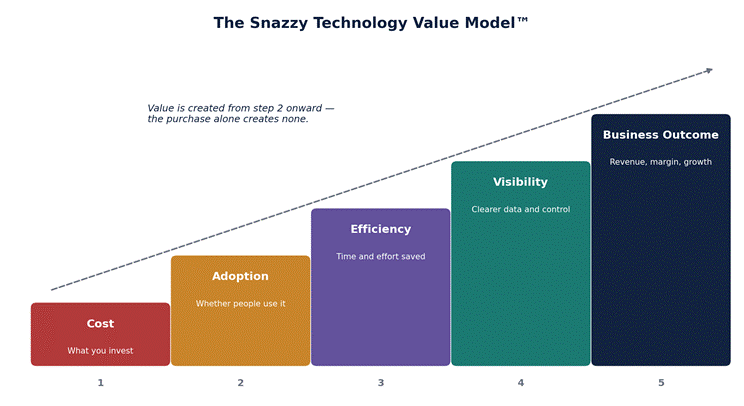
Cost is the full investment, not just the subscription. Adoption asks whether people are genuinely using the technology. Efficiency measures the time, effort and errors removed from real work. Visibility looks at whether leaders now see clearer, faster, more reliable information. Business Outcome connects all of it to something the business cares about: revenue, margin, retention or growth capacity.
The model is useful because it shows where value is being lost. If cost is high and adoption is low, the problem is rollout, not the tool. If adoption is strong but outcomes are flat, the technology may be solving the wrong problem.
The Technology Investment Lifecycle
Technology spending does not follow a straight line, and neither does value. Cost is front-loaded: the business pays for purchase, setup and training before it receives much in return. Value arrives later, once the technology is embedded in daily work. The point where cumulative value overtakes cost is the break-even point, and how quickly it arrives depends almost entirely on adoption.
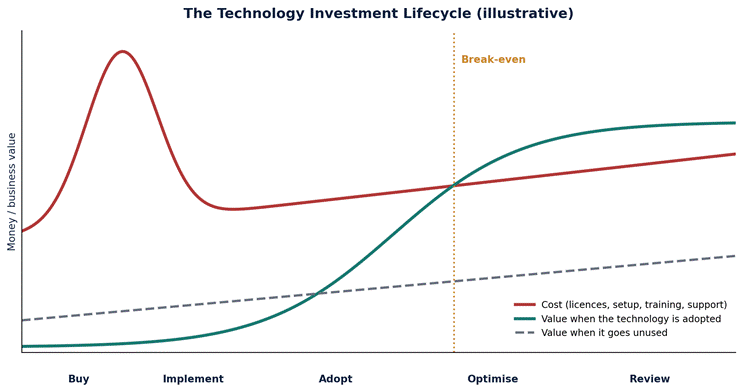
This is why measuring ROI after two weeks is misleading, and why never measuring it is worse. A review at a planned date, with agreed measures, shows whether the investment is on its way to break-even or stuck below it.
What to Measure: The Four Kinds of Technology Value
Technology value shows up in a handful of places. Most investments should be assessed against at least three of them.
Productivity gains and reduced manual work
The most direct return is time. Measure how long a task took before and after, and how many hours of repeated manual work have been removed. Time saved only counts as value if it is redirected to work that matters, so track what the freed time is being used for.
Fewer errors and less rework
Errors have a cost: correction time, refunds, delays, damaged trust. Compare error or rework rates before and after the change. A system that removes duplicate data entry often shows returns here first.
Improved visibility
Better information changes the quality of decisions, which is harder to price but real. Measure how quickly leaders can get an answer to a basic question, such as current sales, stock or workload, and whether decisions are being made on data instead of estimates.
Revenue opportunities
Some technology pays back by helping the business earn more: faster response to leads, better customer experience, new services or the capacity to serve more customers without adding headcount. These effects take longer to appear but often carry the largest return.
An Outcome Measurement Table
A simple table agreed before the technology goes live turns “is it working?” into a question with an answer:
| Value area | What to measure | How to measure it |
| Adoption | Share of intended users actively using the system | Login and feature usage reports, reviewed monthly |
| Efficiency | Time to complete key tasks; manual hours removed | Time sampling before and after; team estimates checked against system data |
| Accuracy | Error, rework or correction rates | Count of corrections or complaints per period |
| Visibility | Time to get a reliable answer; reports produced automatically | Time to produce core reports; reliance on manual spreadsheets |
| Business outcome | Revenue, margin, retention or capacity linked to the change | Compare against the baseline set before launch |
| Total cost | Subscription, setup, training, support and internal time | Finance records plus an estimate of internal hours |
For choosing which numbers are worth tracking in the first place, see “If You Can’t Measure It, You’re Probably Guessing.”
How to Calculate Technology ROI
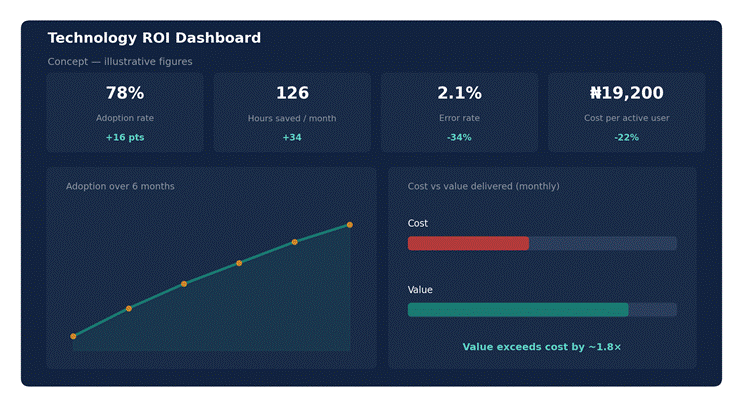
The basic formula is simple: ROI equals value gained minus total cost, divided by total cost. As an illustration, if a system costs ₦12 million over its first year including setup, training and support, and the business can credibly attribute ₦18 million of value to it through time saved, errors avoided and added revenue, the ROI is 50%.
The hard part is not the arithmetic. It is agreeing beforehand what counts as value, setting a baseline, and being honest about what can and cannot be attributed to the technology. A conservative estimate that leadership trusts is worth more than an impressive one nobody believes.
Technology Value Checklist
Before approving or renewing any technology investment, check:
☐ The total cost of ownership has been estimated, not just the subscription price
☐ A specific business outcome the technology should improve has been named
☐ A baseline measurement exists to compare against
☐ There is a named owner responsible for adoption
☐ Usage is being tracked and reviewed on a regular schedule
☐ A review date has been set to compare results with the original case
☐ Licences that are not being used are reviewed before every renewal
Frequently Asked Questions
How do you measure technology ROI?
Compare the total cost of ownership with the measurable value the technology delivers: time saved, errors reduced, better visibility and revenue gained. Set a baseline before launch and review results against it at a planned date.
What is total cost of ownership for business technology?
It is the full cost of acquiring and running a technology over its life, including subscriptions, implementation, data migration, training, support and renewal increases, not only the purchase price.
How long does it take for technology to pay back?
It varies by system and by how quickly it is adopted. Cost comes early and value arrives as people use the technology in daily work, so break-even depends mostly on adoption speed and how well the rollout was supported.
The Takeaway
Technology does not create value by being owned. It creates value by being used, in work that matters, with results the business can measure. Looking only at what technology costs leaves out the part that decides whether the investment was worth making. Count the full cost, track adoption, measure the efficiency and visibility gained, and connect it all to a business outcome. Then the question stops being what the technology costs, and becomes what it is returning.
Don’t just ask what the technology costs. Ask what the business should gain from it.

Joshua Fasinu is a Computer Science student and technology enthusiast passionate about using technology to solve real-world problems. At Snazzy Digital Techspace, he contributes to technology, automation, product development, and digital innovation, while also exploring AI, software development, and business process automation.
He is driven by a desire to learn, build, collaborate, and create digital solutions that make work and everyday life better.