Technology in business now solves specific, measurable operational problems rather than acting as a general upgrade. In real estate, hospitality, logistics and healthcare specifically, the businesses pulling ahead aren’t the ones with the most software — they’re the ones that identified exactly where their operations were breaking down and applied the right technology to that specific point. This article maps that pattern in each of Snazzy’s four priority sectors: the challenge, the opportunity it creates, the technology that addresses it, and the outcome businesses can expect.
These four industries look unrelated on the surface — property, travel, freight and clinical care don’t share a customer base or a regulatory environment. But operationally, they share a common failure pattern: manual processes that once worked at a smaller scale are now the ceiling on growth, customer experience and staff capacity.
Real Estate: From Manual Follow-Up to Centralised Systems
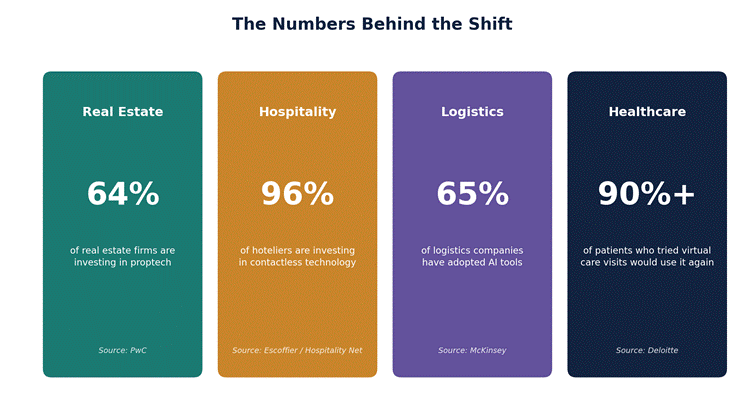
Real estate remains one of the most relationship-dependent industries, and that’s precisely where manual processes cost the most. Agents managing leads across spreadsheets, personal notes and messaging apps routinely lose prospective buyers simply because a follow-up happened a day too late. According to PwC’s Global PropTech Survey, a majority of real estate companies are now investing in or have already invested in proptech specifically to close this gap, and the broader proptech market has grown into a multi-billion-dollar category as a result.
The opportunity isn’t replacing agents — it’s giving them a system that doesn’t forget. A centralised CRM with automated nurture sequences ensures every lead gets a timely follow-up regardless of how busy an agent’s day gets, while automated valuation tools and virtual property tours extend an agent’s reach without extending their hours.
Hospitality: From Friction to Frictionless
Guest expectations in hospitality have shifted faster than most operators’ systems have kept pace with. Research from Oracle and Skift’s hospitality outlook found that a majority of hotel executives expect fully contactless experiences — check-in, payments, room access — to become standard within a few years, and guest surveys consistently show strong demand for contactless check-in to become permanent rather than a temporary convenience.
The businesses already ahead of this shift report measurable gains: hotels that have adopted contactless systems see a significant drop in front-desk congestion and free up meaningful staff time, and guest satisfaction scores climb accordingly. The technology isn’t replacing hospitality’s human element — most guests surveyed say contactless tools don’t diminish the personal touch, provided the technology handles the routine and staff focus on the moments that need a human.
Logistics: From Manual Dispatch to Real-Time Visibility
Logistics has always run on tight margins, and last-mile delivery is where those margins are won or lost — industry estimates put last-mile costs at roughly 41 to 53% of total supply chain spend. Manual dispatch and tracking sheets simply can’t keep pace with the visibility modern shippers and customers expect.
McKinsey research found that a majority of logistics companies have already implemented AI-driven solutions, with early adopters reporting efficiency gains of up to 30% in last-mile delivery specifically. Combined with IoT tracking devices feeding real-time dashboards, logistics providers are moving from reactive problem-solving to predictive planning — catching a delay before a customer has to ask about it.
Healthcare: From Siloed Records to Integrated Care
Healthcare carries the highest stakes of any sector on this list, which makes its technology gaps the most costly. Paper-based or siloed digital records slow down patient care and create real compliance exposure when information doesn’t move as fast as a patient does between departments or providers.
Deloitte’s healthcare outlook found that over 90% of patients who tried a virtual care visit said they would use one again, and a majority of healthcare executives expect meaningful value from AI in both clinical and operational settings going forward. Integrated electronic health records paired with telehealth platforms don’t just improve convenience — they close the information gaps that cause delayed diagnoses and repeated tests.
Introducing The Snazzy Industry Technology Map™
To make these four patterns comparable at a glance, we built The Snazzy Industry Technology Map™ — mapping each sector’s core Challenge, the Opportunity it creates, the Technology that addresses it, and the Outcome that follows.
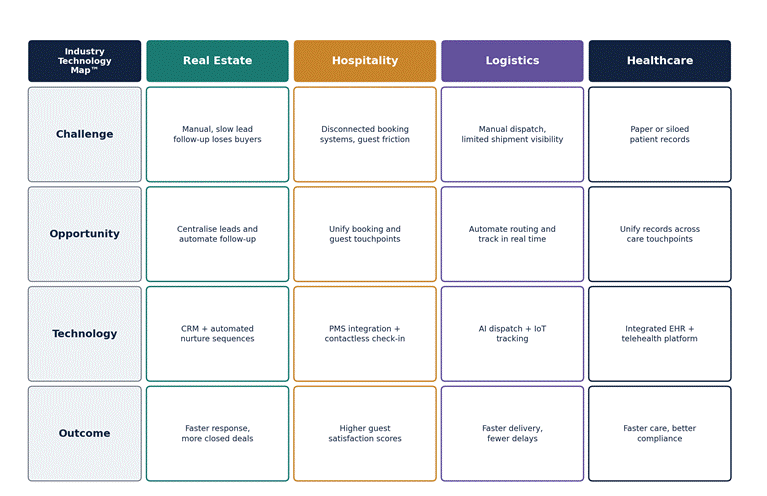
The technology differs by industry. The pattern doesn’t: a specific operational gap, closed by a specific tool, produces a measurable business outcome.
Sources at a Glance
For reference, the key figures cited above and where they come from:
| Industry | Key Statistic | Source |
| Real Estate | 64% of real estate companies are investing in or have already invested in proptech startups | PwC / MetaProp Global PropTech Survey |
| Hospitality | 96% of hoteliers are investing in contactless technology; guest NPS rises 18–25 points after rollout | Escoffier / Hospitality Net |
| Logistics | 65% of logistics companies have implemented AI-driven solutions, with up to 30% efficiency gains in last-mile delivery | McKinsey |
| Healthcare | Over 90% of patients who tried a virtual care visit said they would use one again | Deloitte 2026 U.S. Healthcare Outlook |
Where Does Your Industry Stand?
Before investing in any of the technologies above, it’s worth checking whether the underlying challenge actually matches what your business is experiencing:
☐ Customers or leads regularly wait longer than they should for a response
☐ Staff spend meaningful time each week manually reconciling or re-entering the same information
☐ Leadership can’t see real-time status without asking someone directly
☐ A competitor’s customer experience feels noticeably faster or smoother than yours
☐ The business has grown, but the systems supporting it haven’t changed in step
If two or more apply, the challenge column in the Industry Technology Map™ above is a reasonable place to start — not with a full technology overhaul, but with the specific gap costing the most right now.
Frequently Asked Questions
Which industry benefits most from adopting new technology?
All four sectors covered here show strong, measurable returns from targeted technology adoption — the deciding factor isn’t which industry, but how precisely the technology is matched to a specific operational gap rather than adopted generally.
Is this level of technology investment realistic for smaller businesses?
Yes. Most of the technologies discussed — CRMs, booking system integrations, dispatch and tracking tools, cloud-based EHR platforms — are available as scalable, subscription-based solutions that don’t require enterprise-level budgets to implement.
How do I know which technology to prioritise first?
Start with the challenge costing the business the most right now, not the technology that seems most current — the Industry Technology Map™ above is designed to help identify that starting point for each sector.
The Takeaway
Across real estate, hospitality, logistics and healthcare, the same story keeps repeating: a specific operational gap, once closed with the right technology, produces a measurable improvement in speed, satisfaction or cost. The businesses pulling ahead in each of these sectors aren’t necessarily the best-funded — they’re the ones that mapped their specific challenge to a specific solution instead of adopting technology generally and hoping it helps.
Whichever industry your business operates in, the starting point is the same: identify where the gap actually is before deciding what to buy.
Explore What Technology Can Do for Your Business

Joshua Fasinu is a Computer Science student and technology enthusiast passionate about using technology to solve real-world problems. At Snazzy Digital Techspace, he contributes to technology, automation, product development, and digital innovation, while also exploring AI, software development, and business process automation.
He is driven by a desire to learn, build, collaborate, and create digital solutions that make work and everyday life better.