Business Technology Systems: where people, process and technology meet.
Business technology systems (BTS) is the discipline of designing how people, process and technology work together as one connected system — rather than treating technology as a standalone fix. Most businesses don’t actually have a technology problem; they have a disconnection problem. Tools pile up, teams work in silos, and processes were never built to talk to each other. BTS closes that gap. It is not a platform or a single piece of software — it is the operating philosophy that decides which systems a business genuinely needs, how those systems should connect, and who is accountable for making the connection work. For founders and operations leaders, understanding BTS is the first step toward technology spend that compounds returns instead of quietly adding cost.
Most companies don’t need more software. They need their existing systems to finally talk to each other.
Why Businesses Buy Software but Still Struggle
Walk into almost any growing company and you’ll find a graveyard of good intentions: a CRM nobody fully adopted, a project management tool running parallel to spreadsheets, an accounting system that doesn’t talk to the sales pipeline. None of these tools are bad. The problem is that each one was bought to solve a local, immediate pain — not to fit into a wider system.
Gartner and McKinsey have both tracked this pattern for years: organisations consistently over-invest in new technology while under-investing in the process and change management needed to make it stick, which is a major reason digital transformation initiatives underdeliver on their promised return. The result is technology debt that looks like progress on paper — more dashboards, more subscriptions, more automation rules — but produces very little actual alignment. Decision-makers end up managing tools instead of managing outcomes.
Technology vs. Business Systems: What’s the Difference?
“Technology” is the tool. “A business system” is the working arrangement of people, process and technology that produces a repeatable outcome — onboarding a client, closing a sale, shipping a product, reconciling accounts.
Buying technology answers the question “what tool do we need?” Designing a business system answers a very different question: “what outcome are we trying to produce, and what combination of people, process and technology produces it reliably?” The first question leads to a tool purchase. The second leads to a working system — and it is usually only after the second question is answered that the right tool becomes obvious.
What Is Business Technology Systems (BTS), Really?
Business Technology Systems (BTS) is the practice of intentionally designing the relationship between people, process and technology so that all three move as one system rather than three separate initiatives. It sits above IT strategy and above software selection — it is the layer that decides why a system exists before deciding what runs it.
In practice, BTS asks three questions before a single tool is chosen: Who owns this outcome? What process reliably produces it? What technology removes friction from that process without adding new friction elsewhere? Businesses that answer these questions in order tend to buy less software and get more value from what they do buy.
Introducing the Business Technology Systems Framework™
To make BTS practical rather than theoretical, Snazzy developed the Business Technology Systems Framework™ — a repeatable model built around three pillars and a continuous four-stage cycle.
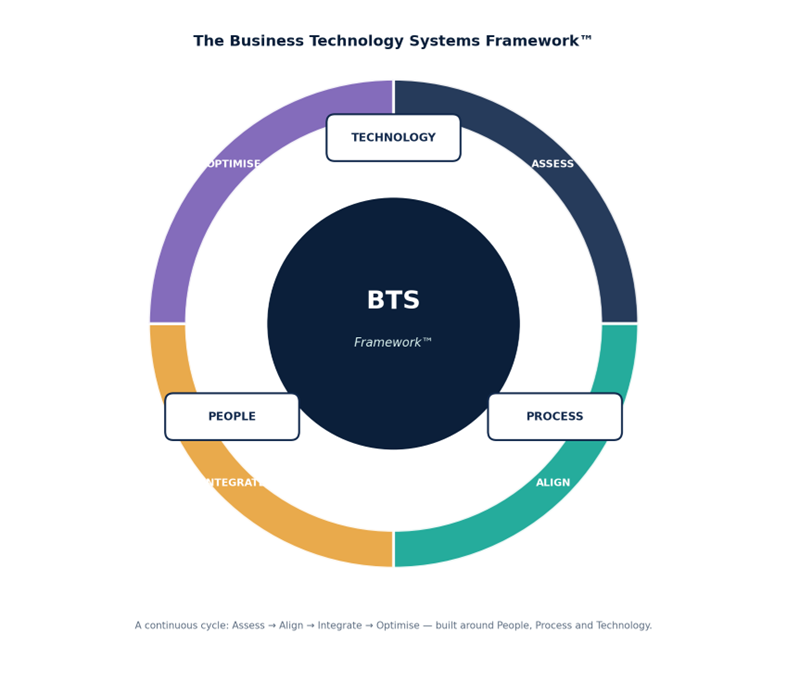
The Business Technology Systems Framework™ — People, Process and Technology aligned through a continuous Assess → Align → Integrate → Optimise cycle.
- People — clear ownership of each system, and the skills to operate it.
- Process — a documented, repeatable way of producing the outcome, independent of any single tool.
- Technology — the platform or tool selected last, specifically because it fits the people and process already defined.
Around these three pillars, the framework runs a continuous cycle rather than a one-off project: Assess the current state honestly, Align people and process before touching technology, Integrate the technology stack so systems share data instead of duplicating it, and Optimise based on what the data actually shows. Because it is a cycle and not a rollout, BTS keeps working as the business changes — it doesn’t expire the day the software goes live.
How BTS Aligns People, Process and Technology
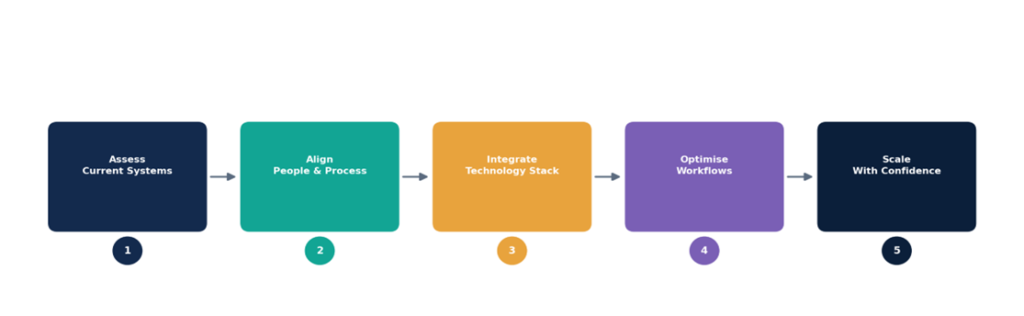
The five-step path from disconnected tools to an aligned, scalable business system
Assess current systems: before adding anything, map what already exists — every tool, every workaround, every manual step someone quietly does to keep things moving. This step alone usually surfaces 30–40% more disconnected tools than leadership expected.
Align people and process: assign clear ownership for each business outcome and document the process in its simplest working form, before any software is involved. A process that only works because one person remembers the steps is not yet a system.
Integrate the technology stack: choose or reconfigure tools so data flows between them automatically. Integration is judged by how little manual re-entry a system requires, not by how many features it has.
Optimise workflows: once live, the system is measured against the outcome it was built for — cycle time, error rate, cost per transaction — and adjusted continuously rather than left alone until the next crisis.
Scale with confidence: because the underlying system is documented and owned, it can absorb more volume, more staff or a new market without being rebuilt from scratch.
A process that only works because one person remembers every step isn’t a system — it’s a single point of failure.
BTS in Practice: Real Business Examples and Measurable Outcomes
A mid-sized logistics operator came to Snazzy with five separate tools handling dispatch, invoicing, client communication, fleet tracking and payroll — none of them connected. Rather than adding a sixth “all-in-one” platform, the BTS assessment stage revealed that dispatch and invoicing shared the same underlying data but were re-entered twice daily by two different staff members. Aligning ownership and integrating just those two systems removed roughly six hours of manual re-entry per week before any new software was purchased.
A professional services firm assumed its client onboarding was slow because of its CRM. The BTS process mapping stage showed the CRM was fine — the process itself had no single owner, so onboarding tasks were duplicated across three team members by default. Reassigning ownership cut onboarding time by roughly a third, with no new technology spend at all. In both cases, the constraint was never really “technology.” It was a disconnected system that technology alone could not fix — and in both cases, the fix cost less than the software everyone assumed they needed.
Traditional Tech Adoption vs. the BTS Approach
| Approach | Traditional Tech Adoption | Business Technology Systems (BTS) |
| Starting point | “What software should we buy?” | “What outcome are we trying to align around?” |
| Ownership | IT or the loudest department | Cross-functional — people, process and technology together |
| Tool count | Grows every year, often unused | Rationalised to what the system actually needs |
| Success measure | Feature adoption, license count | Process time saved, error reduction, decision speed |
| Change management | Afterthought, left to end users | Built into the Assess → Align → Integrate → Optimise cycle |
Frequently Asked Questions
Is BTS the same as digital transformation?
Not quite. Digital transformation typically describes a project — a defined rollout with a start and end date. BTS is the ongoing discipline that determines whether that rollout actually sticks, and it continues after the project team moves on.
Do I need to replace my existing software to adopt BTS?
Usually not. Most BTS engagements reduce the number of new tools purchased because the Assess and Align stages often resolve friction that everyone assumed required new software.
Who should own BTS inside a business?
Ideally a cross-functional owner — often an operations lead or COO — who has visibility across departments, rather than IT alone. Technology decisions made in isolation from process ownership are the most common source of disconnected systems in the first place.
How long does a BTS assessment take?
A focused assessment of a core business function typically takes two to four weeks. A full organisation-wide assessment for a mid-sized business usually runs six to eight weeks, followed by a phased Align and Integrate rollout.
Your BTS Action Checklist
☐ List every tool currently in use across the business, including spreadsheets and manual workarounds.
☐ For each core outcome (sales, onboarding, fulfilment, payroll), name one clear owner.
☐ Identify where the same data is entered manually in more than one place.
☐ Document each core process in its simplest form before evaluating any new software.
☐ Choose technology last — only once the people and process behind it are defined.
☐ Set one measurable outcome per system (cycle time, error rate, cost per transaction) and review it quarterly.
The Bottom Line on Business Technology Systems
Technology will keep evolving, and there will always be a newer platform to evaluate. But business technology systems thinking doesn’t age the same way, because it isn’t about which tool you choose — it’s about whether people, process and technology are designed to work as one system in the first place. Businesses that adopt a BTS approach spend less on software, lose less time to manual workarounds, and scale without having to rebuild their operations from the ground up every few years.
Ready to see where your own systems are disconnected? Explore BTS Solutions with Snazzy Digitals
Joshua Fasinu is a Computer Science student and technology enthusiast passionate about using technology to solve real-world problems. At Snazzy Digital Techspace, he contributes to technology, automation, product development, and digital innovation, while also exploring AI, software development, and business process automation.
He is driven by a desire to learn, build, collaborate, and create digital solutions that make work and everyday life better.